The cost of steel plate and other steel materials is complex and fluctuating, as there are a number of factors, such as President Donald Trump’s tariff trade war, that can impact price. This article has been updated as of May 2026 to reflect these factors.
Steel is typically priced by hundredweight (CWT), which is the price per 100 pounds of material. In some situations – such as materials market reports – carbon steel price may be reflected per-pound. For example, a CWT price of $40* is equal to $0.40 per pound.
To complicate pricing more, units are often quoted in tons, with 1 ton equaling 2,000 pounds.
So, for example:
2,000 pounds = 1 ton = $40 CWT x [2,000 pounds / 100 pounds]
1 ton = $800*
*The price used in this example is arbitrary and not based on current market levels.
Because steel plate is typically priced by CWT, understanding your order’s weight can be helpful in estimating costs. Factors such as thickness – or gauge – and size impact the material’s weight and, therefore, its cost. Use our calculator below to determine weight using the thickness, width, length and quantity.
Market Prices and Supply & Demand
Steel is a basic raw material that is dictated by the laws of supply and demand, which results in an average market price. Excess supply leads to lower market prices, while limited supply drives market prices higher.
In general, supply and demand are the most important factors in determining the price of steel at any given moment in time. These market prices change from day-to-day, and sometimes multiple times per day.
Day-to-day fluctuations in price are typically small, meaning it won’t greatly impact the cost of small-to-medium-sized projects. However, for large projects – let’s say a project that requires 10,000 tons of steel – a $1 increase in CWT would add $200,000 to the bill.
Understanding how steel plate pricing has evolved over time is essential for identifying market trends and planning procurement strategies. To provide a clear snapshot, the following chart highlights the average base gauge (3/8-2in thick) A36 prices for steel plate from 2021 through 2025. This period captures significant market volatility, including pandemic-related disruptions, supply chain constraints and subsequent stabilization, offering valuable context for how pricing has shifted year over year.
| Year | Avg. $ / Net Ton | Avg. $ / CWT | Avg. $ / 1” x 96” x 240” steel plate |
| 2021 | $1,398 | $69.90 | $4,568 |
| 2022 | $1,749 | $87.45 | $5,715 |
| 2023 | $1,468 | $73.40 | $4,797 |
| 2024 | $1,071 | $53.55 | $3,499 |
| 2025 | $1,035 | $51.75 | $3,382 |
| (Jan-May) 2026 | $1,120 | $56.00 | $3,654 |
Let’s now explore the factors impacting daily steel prices.
#1: Steel Grade
Someone buying a car can expect to pay more for a top-of-the-line SUV than they would a compact economy vehicle.
The same is true with steel. Certain grades are inherently more expensive than others.
In general, the CWT increases as the steel grade becomes more specialized – either by adding alloys or using quenched and tempering processes to harden the material.
Below are general steel material categories, ranked from lowest-price to highest.**
• Mild Carbon (ex: A36)
• High Strength Low Alloy (ex: A572)
• Pressure Vessel Quality (ex: A516)
• Offshore & Marine (ex: API 2H grade 50)
• Quenched & Tempered (ex: A514)
• Abrasion Resistant (ex: AR400)
**There are exceptions within each category. For example, A656 is a specialty High Strength Low Alloy grade, but is priced more in the range of Quenched & Tempered grades. Conversely, AR-Medium is an Abrasion Resistant grade, but its pricing is more in the range of Pressure Vessel Quality grades.
When soliciting quotes for a project, understand that certain grades will have a higher CWT than others. A full quote should list CWT for each grade. If it does not, it is certainly acceptable to ask. This can help you compare apples-to-apples between quotes.
#2: Order Quantity
As with anything, buying in bulk often lowers per unit costs. The same is true with steel depending on the current market conditions. If supply is readily available, there could be an opportunity to save with a bulk buy.
When buying in bulk, suppliers can build time savings (such as speed and human resources) into CWT.
Additionally, bulk orders enable the supplier to buy in larger bulk from a mill manufacturer, which sees similar time-savings advantages that are passed on through their CWT.
#3: Future Needs
Don’t have a bulk-quantity need? No problem.
Your needs over time can still impact CWT price. Someone who needs one piece of AR500 steel plate for a target practice backdrop has less future need than someone who requires one piece of AR500 per month for five years.
When submitting your project needs to a steel supplier, be sure to indicate future needs, even if buying in smaller quantities. This insight will help the supplier offer a more accurate quoted price on this and future orders.
#4: Steel Melt & Manufacture Origin
The country of origin where the steel material is produced can play a large factor into overall CWT price. Some projects require specific countries of origin to meet quality requirements, but others can be more flexible about where the material originates.
Click here to learn more about the difference between foreign and domestic steel.
Look for suppliers who source from domestic as well as international mills. These suppliers are more likely to have a wider price range of steel material, giving you more options when you buy.
#5: Steel Processing
Requesting steel material that is cut, drilled or cleaned will likely add to the overall cost. However, savings can be made by having the supplier handle processing in-house, rather than incurring additional expenses to ship material to another company for processing.
Related: Common Ways Steel Plate is Processed
By bundling a material order with a processing request, customers benefit from streamlined logistics and potentially lower overall project costs. Be sure to mention any processing needs you may have with suppliers as you solicit quotes.
#6: Steel Material Location
It is costly – in both time and dollars – to transport steel material due to size and weight. For this reason, quality steel suppliers have distribution centers in strategic cities across North America. This allows the supplier to deliver steel faster and more economically to customers across the continent.
A few suppliers build transportation cost into CWT, but most tack it on as an additional expense. When evaluating steel material quotes, be sure to understand how transportation will impact your total cost.
#7: Grade Liquidation
Occasionally, a steel supplier may have too much of a non-standard size or grade and will slash CWT in order to move the material (and clear warehouse space for more popular sizes and grades).
If a project has flexibility around a size and/or grade, it is certainly worth mentioning as you solicit quotes.
#8: Supplier Niche
When sourcing steel materials, partnering with a niche supplier can save greatly on CWT. For example, Leeco Steel specializes exclusively in supplying steel plate. Because this is our focus, we can be much more competitive on steel plate pricing than someone who supplies a more mixed variety of steel products (i.e. bars, coils and sheet).
However, sometimes your project requires more varied material types. In these cases, you should evaluate the time saved by working with a general “one-stop-shop” supplier and if it outweighs the CWT savings that can be offered by a niche supplier.
#9: Prime vs. Secondary Materials
Whether you purchase prime steel plate or secondary steel plate can also determine material cost.
Prime steel plate meets regulatory or mill proprietary specifications for chemical and physical properties. This material is the bulk of what is sold by Leeco Steel and is priced at standard rates.
Secondary steel plate, also known as sub-prime plate, does not conform to regulatory specifications due to slight imperfections, such as not meeting flatness standards, having a poor surface or missing chemical or physical properties. These imperfections make secondary steel plate less expensive than prime steel plate. Secondary steel plate is typically used in non-structural applications that do not require ASTM specifications.
When sourcing steel plate for your project, consider whether secondary plate could be an option for your application, or if your application requires prime plate.
#10: Market Regulation
Market regulation can greatly impact global and domestic CWT.
Tariffs placed on steel imports can make buying materials with non-domestic origins more expensive, thus resulting in greater demand for lower-priced domestic materials. Basic macroeconomics then take hold: greater demand lowers the supply and increases prices.
Governments will also sometimes subsidize domestic steel producers, allowing the material to be priced below what it actually costs to produce. This form of regulation can have a ripple effect and impact steel prices across the globe. These market dynamics can cause other countries to file dumping cases and to have duties added to imported steel if it is subsidized.
Whatever the regulation, it can have a major impact in CWT across the board.
As of May 2026, President Trump has strengthened tariffs on imported aluminum, steel and copper in order to protect the national security of the United States. Articles made entirely or almost entirely of aluminum, steel or copper will pay a flat 50% on their full value. Derivative articles substantially made of steel, aluminum or copper will play a flat 25% on their full value.
According to Tax Foundation, President Trump imposed tariffs on nearly all trading partners under the International Emergency Economic Powers Act (IEEPA) and on several sectors using Section 232. On February 20, 2026, the Supreme Court ruled that IEEPA does not authorize tariffs, leaving only the new Section 232 tariffs in place. Trump responded by imposing a 10% tariff on nearly all countries under Section 122, effective February 24, 2026, applying to an estimated $1.2 trillion of annual imports. The Section 122 tariff is scheduled to expire after 150 days, and several new Section 301 investigations are ongoing.
#11: Government Bills & Legislation
Government bills and legislation passed can have a significant impact on steel plate demand.
The Inflation Reduction Act (IRA) and Infrastructure Investment & Jobs Act (IIJA) are two bills that provide billions in funding to sectors that extensively use steel products, such as wind and solar energy, manufacturing, roads and bridges. Through initiatives like the Department of Energy’s Loan Programs Office, the IRA allocates billions in credit subsidies to unlock hundreds of billions in new loan authority. This includes funding dedicated to clean energy supply chains, advanced technology vehicle manufacturing and the Energy Infrastructure Reinvestment (EIR) Program, which focuses on revising or replacing retired energy infrastructure.
While there have been executive orders that have paused some funding under both Acts, many projects are still underway. The IIJA’s funding is set to expire in September 2026. Meanwhile, key loan authorities under the IRA are also bound to statutory timelines: its Title 17 clean energy financing is available through September 30, 2026, while expanded programs for advanced transportation and tribal energy finance extend through September 30, 2028.
As funds from these bills are dispersed in 2026 and beyond, demand for steel plate will increase, which could drive prices upwards if demand outpaces supply.
#12: Raw Materials
The cost and availability of raw materials used to produce steel can have a major influence on the price of the finished product.
If the price of raw materials used to make steel – such as electricity, natural gas, iron ore, pig iron or scrap metal – goes up, so does the total production cost. Steel producers have no choice but to pass these additional production costs to their buyers by increasing the price of the end product.
The availability of raw materials also impacts steel production. If there is a shortage of a raw material used to make steel, production will slow and available supply will deplete, which could place upward pressure on steel plate prices.
The global steel industry is increasingly shifting toward carbon neutral production methods, driven by environmental regulations and market demand for sustainable materials. As more steel mills produce carbon neutral steel – also known as “green steel” – use of electric arc furnaces (EAFs) and scrap metals is expected to increase. Additionally, many mills such as SSAB, ArcelorMittal and Nippon Steel are aiming to use renewable energy sources in steel production rather than fossil fuels, and this change in energy source could also factor into production cost.
#13: Natural Disasters & Conflicts
Unpredictable and unstoppable, natural disasters can be devastating. Communities find themselves needing to rebuild buildings, bridges, utilities and more. In the wake of natural disasters, demand for steel material needed for rebuilding can push prices temporarily higher across the market.
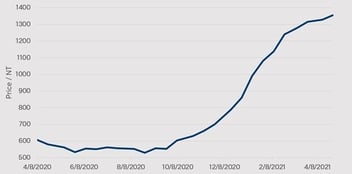
The COVID-19 pandemic, for example, disrupted supply and demand in 2020 and 2021. Demand for steel plate recovered at a much faster pace than supply, as many steel mills slowed production during the pandemic. This caused steel plate prices to rapidly rise as demand outpaced available supply.
Wars and conflicts can also disrupt the steel market through economic sanctions or supply chain and production constraints. An example of this was the start of the war between Ukraine and Russia in 2022. Ukraine and Russia were both major producers and exporters of raw materials used to make steel, so the conflict between the two countries impacted available steel supply that year. Many countries also enacted economic sanctions on Russia, which restricted steel imports of Russian material.
These instances are – thankfully – rare, but natural disasters and conflicts remain a significant factor in determining steel material price.
Despite touching on 13 factors that impact steel material pricing, this list is not exhaustive. However, armed with a better understanding of the major players in steel material pricing, you are better equipped to find the right steel material supplier for your project needs.
We encourage you to submit your projects that require steel plate material to Leeco Steel for quoting, as we offer some of the most competitive steel plate pricing the U.S., Canada and Mexico. Use our simple quote builder tool or submit your list of requirements to Leeco Steel today.